
Sub-Total: $0.00
Yoga sound bath sequence examples: a practical guide
Yoga sound bath sequence examples: a practical guide
A yoga sound bath sequence is a structured practice combining restorative yoga postures with live or recorded healing sound to guide the nervous system from active alertness into deep rest. These sequences are not random pairings of poses and music. They follow a deliberate arc, moving from gentle physical effort through supported stillness and into full sound immersion. Whether you are practising at home or designing sessions for a group class, understanding proven yoga sound bath sequence examples gives you a reliable framework to work from rather than guessing what comes next.
1. What does an effective yoga sound bath sequence look like?
A well-structured yoga sound bath sequence follows a graded descent from active movement to supported poses to complete stillness, with sound deepening at each stage. This principle is the foundation of every format described in this article. Without it, participants struggle to release tension because the body has not been given permission to let go progressively.
Most sequences divide into five recognisable phases. The arrival phase (3 to 5 minutes) uses breath awareness and body scanning to settle the mind. A supported pose phase (5 to 8 minutes) introduces low-effort positions such as reclined bound angle or legs up the wall. A heart or hip opening phase (8 to 12 minutes) uses bolsters, blocks, and blankets to open the chest or hips passively. A side-lying rest phase (5 to 10 minutes) transitions the body before savasana. A closing phase (2 to 4 minutes) brings gentle awareness back to the room. Beginner sessions typically run 15 to 20 minutes, while complete practices span 25 to 40 minutes.
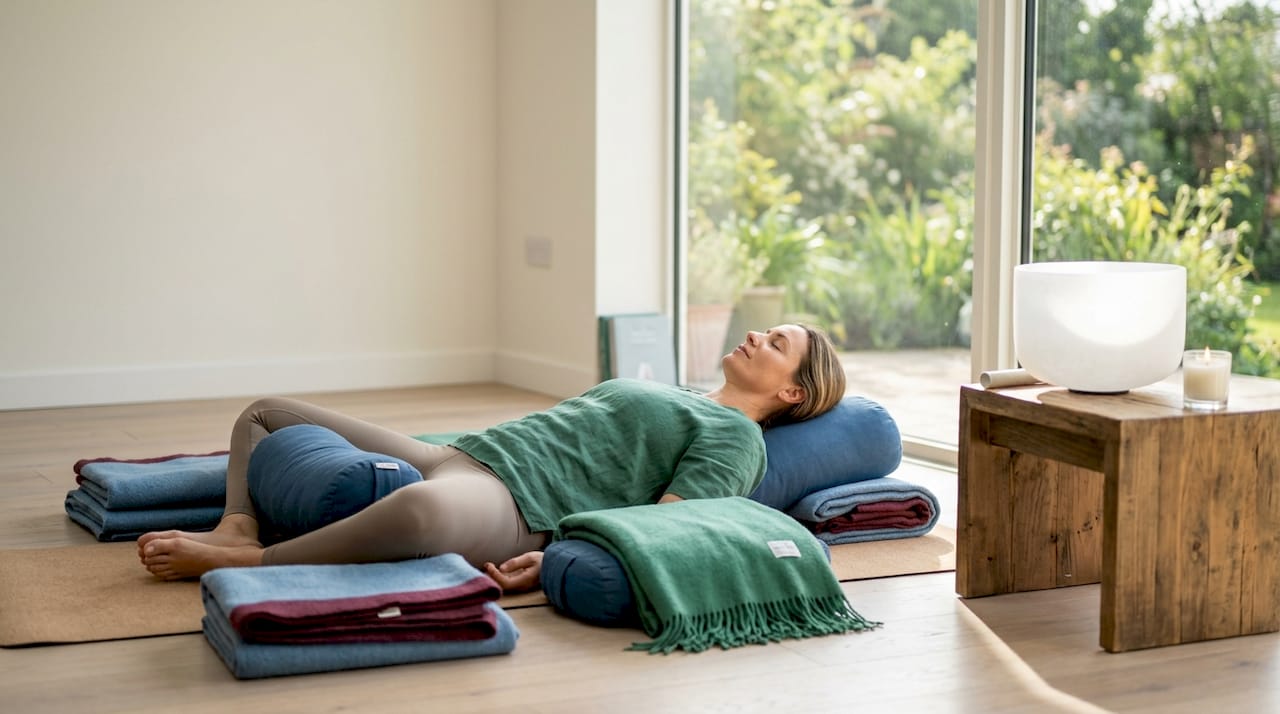
Sound tools enter the sequence at specific moments rather than running continuously from the start. Crystal singing bowls work well during the supported pose and savasana phases because their sustained tones encourage slow brainwave activity. Tuning forks suit the arrival phase, where precision and subtlety matter more than volume. Ambient recordings or gongs layer in during the deepest rest phase to create a continuous sound field.
Pro Tip: Introduce your primary instrument gradually. Strike a crystal singing bowl once during the arrival phase so participants register the sound before it becomes the dominant sensory input. This primes the nervous system rather than startling it.
2. At-home DIY sequence: a step-by-step example
An at-home yoga sound bath sequence is the most accessible format and requires no prior musical training. Using props from the start, such as bolsters, folded blankets, and eye pillows, reduces muscular effort so attention can shift fully to sound. The goal is to make every pose “suspiciously easy,” meaning no position should require active holding or balancing.
A practical 30-minute at-home sequence looks like this:
- Minutes 0 to 4 (arrival): Lie in constructive rest with knees bent, feet flat, hands on belly. Play a single tuning fork or a low ambient track. Focus on natural breath.
- Minutes 4 to 12 (supported child’s pose or reclined rest): Move into a fully bolstered child’s pose or reclined bound angle with a blanket under the knees. Begin a crystal singing bowl track or strike a bowl every 60 to 90 seconds.
- Minutes 12 to 22 (supported heart opener): Place a bolster lengthways under the spine for a gentle chest opening. Allow the arms to fall open. Let the sound layer build with a second bowl tone or a gong recording.
- Minutes 22 to 28 (side-lying rest): Roll to the right side with a pillow between the knees. Reduce sound volume or allow silence for 2 minutes before a final bowl strike.
- Minutes 28 to 30 (closing): Return to constructive rest. Three slow breaths. Gentle movement of fingers and toes.
“The most effective at-home sound bath sequences are the ones you will actually repeat. Simplicity and consistency matter more than instrument variety.”
3. Teacher-led slow flow: a class format example
A teacher-led slow flow class integrates movement and sound across a longer arc, typically 45 minutes. This format opens with 5 minutes of breath orientation, moves into 15 minutes of slow floor-based movement, transitions into a 15-minute supported sound bath, and closes with 10 minutes of integration and savasana.
The slow flow section keeps all transitions low to the ground. Poses such as supine twists, reclined figure-four, and gentle cat-cow on hands and knees maintain a consistent breath rhythm. Slow transitions mean students do not need to recalibrate their nervous system with each movement, which preserves the calm state built during the opening breathwork. Sound enters lightly during the flow section, perhaps a single sustained bowl tone between pose transitions, before becoming the primary focus during the rest phase.
Sound layering in a teacher-led class follows a graded arc. Low tones from a large crystal singing bowl or a bass gong open the sound bath phase. Mid-range tones from smaller bowls or chimes layer in after 3 to 4 minutes. The arc then descends back to low tones before silence closes the session. Sound transitions work best as pacing tools rather than novelty cues, with each audio section running for several uninterrupted minutes to allow genuine nervous system integration.
4. Yoga Nidra and sound bath combinations
Yoga Nidra combined with a sound bath is one of the most powerful formats for deep rest. This combination uses guided body scanning and breath awareness meditation to bring participants to the threshold between waking and sleep, then layers crystal singing bowls to deepen the state further. Participants lie on yoga beds or mats with pillows and blankets throughout.
A typical Yoga Nidra sound bath session follows this structure:
- Opening (5 minutes): Settling into savasana, setting a sankalpa (personal intention), and breath awareness.
- Body scan (10 to 15 minutes): Guided rotation of awareness through body parts, spoken slowly. Crystal singing bowls play softly in the background at low volume.
- Pairs of opposites (5 minutes): Guided visualisation using sensory contrasts such as warmth and coolness. Bowl tones increase slightly in presence.
- Deep sound immersion (15 to 20 minutes): Full sound bath with crystal singing bowls, chimes, or ambient instruments. No verbal guidance. Pure sound.
- Return (5 minutes): Gentle verbal guidance back to waking awareness, slow movement, and closing.
Sound baths reduce tension and support nervous system regulation, making them well suited to the hypnagogic state that Yoga Nidra cultivates. Beginners find this format particularly accessible because the guided body scan removes the pressure to “meditate correctly.” The sound does the work once the body scan has lowered mental resistance.
5. Comparing sequence types: which format suits your purpose?
Different yoga sound journey formats serve different contexts. The table below compares the four main sequence types by duration, sound approach, pose selection, and best use case.
| Format | Duration | Sound approach | Pose selection | Best for |
|---|---|---|---|---|
| At-home DIY | 25 to 40 min | Recorded tracks or single bowl | Fully supported, minimal transitions | Personal daily practice |
| Teacher-led slow flow | 45 min | Live layered instruments | Floor-based flow into savasana | Group classes, studios |
| Yoga Nidra hybrid | 45 to 60 min | Soft background then full immersion | Savasana throughout | Deep rest, therapeutic use |
| Immersive workshop | 60 min+ | 7 chakra crystal bowls, gongs, chimes | Extended savasana | Workshops, events |
Choosing between these formats depends on three factors: the experience level of participants, the time available, and the instruments at hand. A beginner group benefits most from the at-home DIY structure because its simplicity reduces overwhelm. An experienced studio class can handle the slow flow format because participants are comfortable with floor transitions. Yoga Nidra combinations suit therapeutic or wellness retreat settings where extended rest is the primary goal.
Pro Tip: When designing for a mixed-ability group, default to the most supported format available. A bolster under every participant from the start signals that rest is the priority, which lowers the threshold for nervous system release regardless of experience level.
Breathwork combined with a sound bath adds another layer to any of these formats. A 5-minute guided breath activation before the sound phase opens the body and releases surface tension, making the subsequent sound immersion noticeably deeper. This pairing works particularly well in workshop settings where participants have more time and are seeking emotional release alongside physical relaxation.
Key takeaways
Effective yoga sound bath sequences follow a graded arc from gentle movement to full stillness, with sound deepening progressively at each phase to support genuine nervous system reset.
| Point | Details |
|---|---|
| Graded descent is the core principle | Move from active effort to supported poses to stillness before introducing full sound immersion. |
| Timing phases guide every format | Arrival, supported poses, heart or hip opening, side-lying rest, and closing apply across all sequence types. |
| Sound as a pacing tool | Let each sound section run for several uninterrupted minutes rather than switching instruments frequently. |
| Props reduce effort from the start | Bolsters, blankets, and eye pillows allow full sensory engagement without muscular distraction. |
| Format choice follows context | Match the sequence type to participant experience level, session length, and available instruments. |
What I have learnt from sequencing sound baths
I spent years teaching yoga before I understood that the sequence itself is a sound healing instrument. The order of poses, the timing of each transition, and the moment you introduce the first bowl tone all shape the participant’s nervous system response before a single note sustains.
The mistake I see most often, in both personal practice and group classes, is introducing too much sound too soon. When a crystal singing bowl plays during the arrival phase at full volume, participants tense rather than soften. The nervous system reads intensity as a signal to stay alert. Starting with a single quiet strike and allowing the room to absorb it changes everything. By the time the full sound bath begins, the body is already primed to receive it.
I also think the obsession with instrument variety is overrated for beginners. One well-played crystal singing bowl, used consistently across a 30-minute sequence, produces deeper results than six instruments played without intention. The sound meditation focus techniques that genuinely support relaxation are about sustained attention, not sonic complexity. Simplicity, repeated with care, builds the trust that allows deep rest.
If you are designing sequences for others, I would encourage you to practise the sequence on yourself first, at least three times, before teaching it. You will notice where the pacing feels rushed, where a pose needs more support, and where the sound transition lands awkwardly. That self-knowledge is what separates a sequence that works from one that merely looks good on paper.
— Sarah
Take your sound bath practice further with Soundbathtraining
If these sequence examples have sparked an interest in facilitating sound baths professionally, Soundbathtraining offers accredited courses designed for practitioners at every level, including those with no prior musical background.
The accredited sound healing courses at Soundbathtraining cover everything from instrument technique and sequence design to working with groups in therapeutic settings. For those specifically drawn to crystal singing bowls, the crystal singing bowl course provides hands-on training in a small-group studio environment with a high instructor-to-trainee ratio. Whether you want to deepen your personal practice or build a professional offering, structured training gives you the confidence to design sequences that genuinely serve your participants.
FAQ
What is the standard format for a yoga sound bath?
A standard yoga sound bath format moves through five phases: arrival and breath awareness, supported poses, heart or hip opening, side-lying rest, and a closing. Sessions range from 25 to 40 minutes for personal practice and up to 60 minutes or more for workshops.
How does Yoga Nidra combine with a sound bath?
Yoga Nidra guides participants through a body scan and breath awareness meditation before transitioning into full sound immersion using crystal singing bowls. The body scan lowers mental resistance so the subsequent sound bath produces deeper relaxation.
Which yoga poses work best in a sound bath sequence?
Fully supported poses such as reclined bound angle, bolstered child’s pose, supported heart opener, and savasana work best because they require no active muscular effort. Low effort allows the body to focus entirely on receiving sound.
How long should each sound section last?
Each sound section should run for at least 3 to 5 uninterrupted minutes to allow the nervous system to integrate the vibration. Frequent instrument changes disrupt the calming effect and reduce the depth of relaxation participants can reach.
Do I need multiple instruments to run a sound bath sequence?
One well-played crystal singing bowl is sufficient for a complete at-home or beginner sequence. Instrument variety adds texture in workshop settings but is not required for an effective practice.