
Sub-Total: $0.00
The role of intention in sound healing

The role of intention in sound healing
Intention in sound healing is the purposeful mental and emotional focus that directs the healing process, acting as the primary mechanism that activates and amplifies the effects of sound therapy. When you enter a sound bath with a clear intention, whether that is emotional release, grounding, or deep rest, you are not a passive recipient. You become an active co-creator of the experience. Research now confirms that this mental framing produces measurable physiological changes, including shifts in cortisol levels and heart rate variability. Singing bowls, gongs, and binaural beats all carry frequency, but intention is what gives that frequency direction.
What evidence supports the role of intention in sound healing?
Sound healing, formally studied within music therapy and psychoacoustics, produces consistent physiological results when intention is part of the protocol. Sound healing practices reduce cortisol by an average of 23% and improve heart rate variability across a meta-analysis of 104 randomised trials. That figure matters because cortisol reduction is a direct marker of nervous system regulation, the very state that makes deeper healing possible.
The connection between intention and emotional breakthrough is equally well documented. A 2026 study published in Frontiers in Psychology found that combining meditation with music that induces aesthetic chills significantly enhances self-transcendence and psychological insight compared to meditation alone. The implication is clear: when you bring meaningful framing, which is intention, to a sound experience, the emotional and cognitive benefits multiply.
“Intention modulates expectation, relationship, and ritual, all of which are active healing factors, not passive background noise.” This framing, drawn from biofield and sacred sound research, positions intention as a measurable physiological variable rather than a metaphysical concept.
One honest caveat: measuring intention in isolation is methodologically difficult. Trial designs struggle to blind participants to their own mental states, and sample sizes in sound healing research remain small. The evidence base is growing, but it rewards sceptical optimism rather than absolute claims. What the data does support is that intention is integral to intervention design, not an optional add-on layered over the sound.
How does intention function during a sound healing session?
Practitioners who work with singing bowls, Tibetan bowls, or gongs do not simply play instruments and hope for the best. They select an intention before the session begins, align their instrument choices to that intention, and hold that focus throughout the experience. A pre-session intention step helps align all session elements and directly influences nervous system responses in both practitioner and participant.
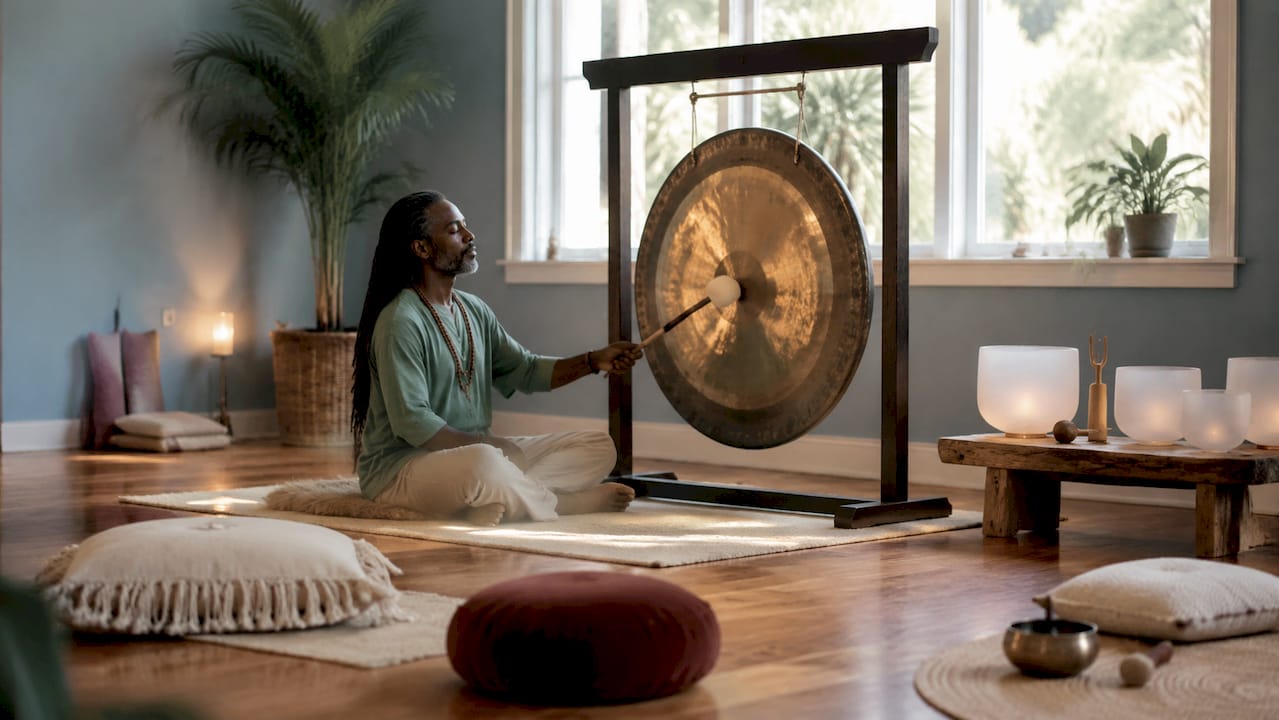
The process for participants mirrors what therapists call attunement. A 2026 realist evaluation of music therapy in dementia care found that tailored musical care plans reduce distress and improve personhood when therapeutic intention is embedded in the relational context, not just the sound itself. This tells us that the relationship between practitioner and participant, shaped by shared intention, is part of the mechanism.
Here is a practical framework for setting intention before any sound healing session:
- Arrive early and settle. Spend two to three minutes in stillness before the session begins. Rushing in from a busy street and expecting immediate depth is unrealistic.
- Name one clear intention. Choose a single focus: emotional release, grounding, clarity, or rest. Vague intentions produce vague experiences.
- Anchor it in the body. Place a hand on your heart or belly and feel where the intention lives physically. This moves it from concept to sensation.
- Hold it lightly. Intention is not a demand. Set it, then release attachment to a specific outcome. Rigidity blocks the very openness that sound healing requires.
- Return to it gently. When the mind wanders during the session, use the intention as a soft anchor, not a command.
Pro Tip: If you find your mind drifting repeatedly during a session, try pairing your intention with a simple breath pattern. Inhale into the intention, exhale to release resistance. This technique, used widely in sound meditation practice, keeps attention embodied rather than purely conceptual.
What types of intention work best in sound healing?
Intentions in sound healing broadly fall into five categories, each of which shapes both the practitioner’s instrument choices and the participant’s inner experience. Understanding these categories helps you match your personal wellness goals to the right session type.
- Emotional release: Targets grief, anger, or stored tension. Practitioners often favour lower-frequency instruments such as gongs or large Tibetan bowls to support this intention, as their resonance encourages physical relaxation and emotional softening.
- Grounding: Focuses on stability, presence, and connection to the body. Earth-toned frequencies and slow rhythmic patterns complement this intention well.
- Mental clarity and focus: Supports decision-making, creative blocks, or cognitive fatigue. Higher-pitched crystal singing bowls and binaural beats are commonly paired with this intention.
- Heart opening: Cultivates compassion, self-love, or relational healing. Mid-range frequencies and harmonically rich instruments tend to support this state.
- Deep rest and sleep preparation: Aims for parasympathetic activation and surrender. Long, sustained tones with minimal variation are most effective here.
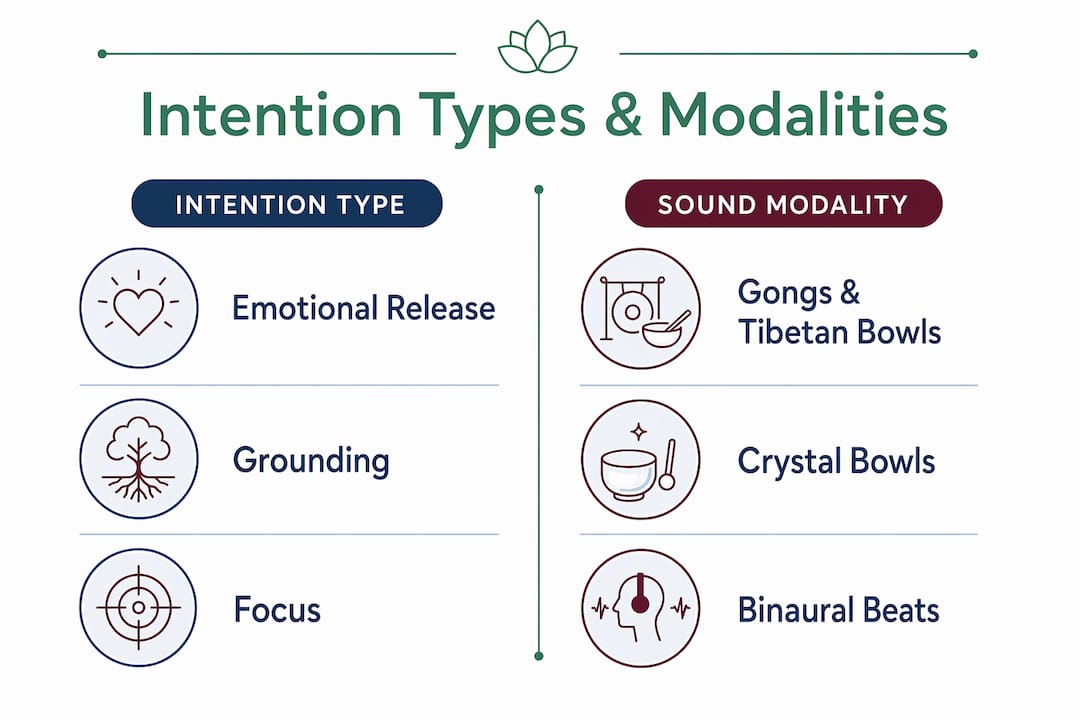
The table below maps these intention types to the sound modalities most commonly used in practice:
| Intention type | Typical sound modality |
|---|---|
| Emotional release | Gongs, large Tibetan bowls |
| Grounding | Drumming, low-frequency bowls |
| Mental clarity | Crystal singing bowls, binaural beats |
| Heart opening | Harmonically layered bowls, chimes |
| Deep rest | Sustained drones, Himalayan bowls |
Cultural context also shapes how intentions are interpreted. Intention and cultural framing tune both the participant and the environment, making sound rituals simultaneously physical and meaning-laden social experiences. A grounding intention in a Western wellness studio and the same intention within an indigenous ceremonial context carry different symbolic weight, even if the physiological mechanisms overlap.
Binaural beats delivered via headphones show stronger evidence for brainwave entrainment than singing bowls alone, though bowls provide ritual context and tactile vibration that support intention setting in ways headphones cannot replicate. The most effective personal practice often combines both.
How to apply intention effectively in your personal sound practice
Applying intention in a personal sound healing practice requires more than good intentions at the start of a session. It demands an ongoing attentional relationship with the sound throughout the experience. Purposeful listening, defined as active attention to musical meaning and emotional content, enhances mind-body connections and aids emotional healing in ways that passive listening does not.
The most common pitfall is setting an intention and then immediately forgetting it once the sound begins. This happens because sound is absorbing by nature. The solution is to operationalise your intention before the session by designating one or two specific target states and building in a simple attention protocol to track your focus. For example, if your intention is emotional release, you might note any physical sensations of tightness at the start, then check in with those same areas midway through.
- Before the session: Write your intention down in one sentence. This externalises it and makes it concrete.
- During the session: Use focus enhancement techniques such as body scanning or breath awareness to maintain attentional contact with your intention.
- After the session: Spend five minutes in silence before reaching for your phone. Notice what has shifted. Journal briefly if that suits you.
- Over time: Track patterns across sessions. If the same intention repeatedly produces the same emotional response, that is data about where your healing work is concentrated.
Pro Tip: Combining intention with conscious breathwork before a session significantly deepens the experience. Three slow diaphragmatic breaths while holding your intention in mind shifts the nervous system toward parasympathetic dominance before a single note is played. This is one of the simplest and most underused preparation techniques in personal sound practice.
Avoid the trap of treating intention as a performance. Some practitioners and participants become so focused on “doing intention correctly” that they lose the receptive quality the practice requires. Intention functions best as a direction, not a destination.
Key takeaways
Intention is the active ingredient in sound healing, not the sound alone. Without it, frequency is just vibration. With it, vibration becomes medicine.
| Point | Details |
|---|---|
| Intention drives outcomes | Clear mental focus shapes physiological responses including cortisol reduction and heart rate variability. |
| Evidence is real but nuanced | A meta-analysis of 104 trials confirms relaxation effects; intention amplifies these when embedded in session design. |
| Intention types shape practice | Matching your intention to the right sound modality, such as gongs for release or crystal bowls for clarity, improves results. |
| Purposeful listening is active | Passive sound exposure produces less benefit than attention-directed listening anchored to a named intention. |
| Consistency builds depth | Tracking intention responses across multiple sessions reveals patterns and accelerates personal healing progress. |
Why intention is the part most people underestimate
I have sat in hundreds of sound baths and facilitated many more, and the single most consistent observation I can offer is this: the participants who arrive with a clear intention almost always report a more profound experience than those who arrive curious but unfocused. That is not a criticism of curiosity. Curiosity is a fine starting point. But intention is what converts an interesting sensory experience into something that genuinely shifts your inner state.
What surprises most people is how little effort a well-formed intention requires. You do not need to meditate for an hour beforehand or hold a complex visualisation throughout. One sentence, felt in the body, held lightly, is enough. The sound does the rest of the work. Your intention simply tells it where to go.
The science supports this, but the science also has limits. Cortisol measurements and HRV data confirm that something real is happening physiologically. They do not capture the quality of what shifts when a person finally releases grief they have been carrying for years, or the clarity that arrives after a session focused on mental fog. That gap between the measurable and the meaningful is where intention lives. Treating it as either pure metaphysics or pure neuroscience misses the point. It is both, and that is what makes it worth taking seriously.
My advice: start small. Choose one intention per session. Notice what happens. Refine it over time. The practice of setting intentions before a sound healing session is itself a form of self-knowledge, and that alone has value independent of any frequency or instrument.
— Sarah
Deepen your practice with accredited sound healing training
If you are ready to move beyond self-guided exploration and build a grounded, professional understanding of intention-based sound healing, Soundbathtraining offers accredited courses designed for exactly that purpose.
The accredited practitioner training covers all major instruments across four days, with dedicated focus on how intention shapes every element of a sound bath, from instrument selection to session closure. No prior musical background is required. For those starting with crystal bowls specifically, the one-day crystal bowl course provides hands-on training in a small-group studio setting, with a high instructor-to-trainee ratio that supports genuine skill development. Both programmes integrate wellness practices alongside sound technique, making them equally relevant for personal growth and professional application.
FAQ
What is the role of intention in sound healing?
Intention in sound healing is the purposeful mental focus that directs how sound frequencies are received and processed by the mind and body. Research confirms it functions as an active healing factor by modulating expectation, nervous system state, and emotional receptivity.
How do I set intentions before a sound healing session?
Name one clear intention in a single sentence, anchor it with a physical gesture such as a hand on the heart, and hold it lightly throughout the session without demanding a specific outcome. Writing it down beforehand makes it concrete and easier to return to.
Does intention actually change physical outcomes in sound therapy?
Yes. Studies show that sound healing reduces cortisol by an average of 23% and improves heart rate variability, with intention embedded in session design strengthening these effects by shaping nervous system responses.
Can I practise intention-based sound healing at home?
Absolutely. Purposeful listening at home, using crystal bowls, recorded sound baths, or binaural beats, produces measurable benefits when paired with a named intention and active attentional focus rather than passive background listening.
How does intention differ between practitioners and participants?
Practitioners use intention to guide instrument selection, session structure, and relational attunement. Participants use intention to direct their inner focus and emotional receptivity. Both roles are active, and the most effective sessions occur when practitioner and participant intentions are aligned.